


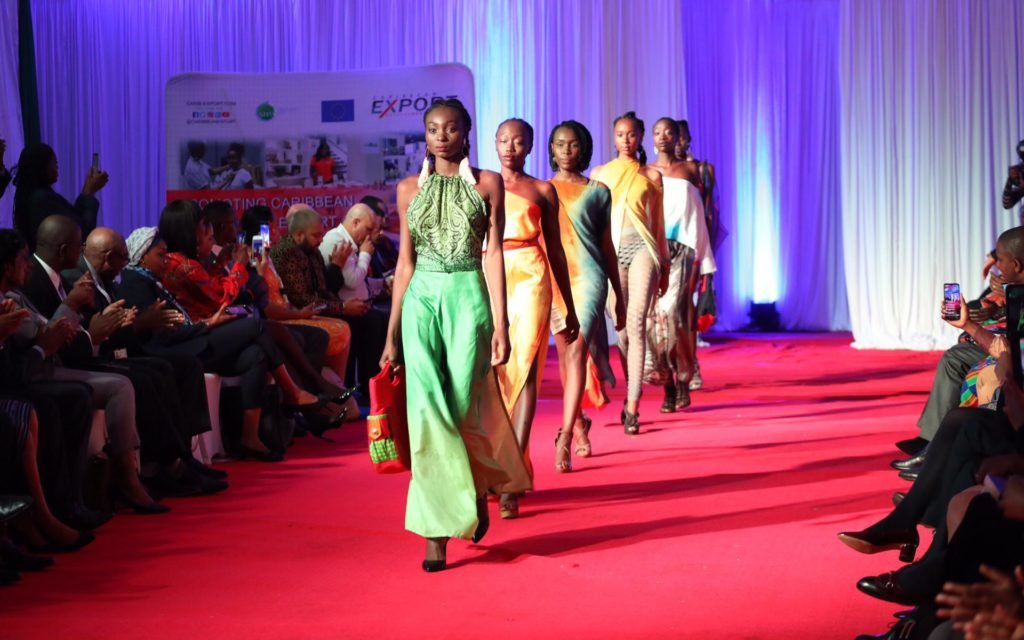

For over two decades, Caribbean Export has been the region’s most consistent institutional champion of fashion as a trade sector. Its record reveals both what systematic support can achieve — and the stubborn structural gaps that persist even after the programmes end.
For many Caribbean creatives, the development agency playbook is predictable: the workshop, the bootcamp, the delegation to a trade fair. In the best cases, these experiences are transformative. In the worst, they are stand-alone moments of exposure that generate enthusiasm but no follow-through infrastructure. The gap between the two outcomes is, in most cases, determined by what comes after the event ends.
The Caribbean Export Development Agency has been navigating this challenge — with varying degrees of success — since the late 1990s. Established in 1995 as the sole regional trade promotion agency of the Caribbean Forum (CARIFORUM), the agency has invested more than a decade of sustained programming in the fashion sector. Its track record is the most detailed institutional account the region has of what it actually takes to try to build a fashion export industry, and what that effort costs when the conditions are not yet right.
The Mandate and the Money
Caribbean Export operates as an implementing partner for development programmes funded primarily by the European Union — chiefly through successive rounds of the European Development Fund‘s Regional Private Sector Development Programme. This funding relationship shapes both the scope of what the agency can do and the timelines within which it must do it.
Fashion sits within the agency’s Creative Industries portfolio, one of nine priority sectors it works across. The sector is treated as a legitimate export category — alongside agro-processing, ICT, and health and wellness — rather than as a cultural activity that occasionally generates revenue. This framing matters: it means fashion entrepreneurs accessing Caribbean Export’s programmes are entering a system designed around commercial outcomes: export readiness, buyer access, wholesale capacity, and revenue generation.
The agency’s fashion work has been consistently co-financed. Its most significant fashion programmes have been implemented in partnership with the Caribbean Development Bank, through CDB’s Cultural and Creative Industries Innovation Fund (CIIF), as well as in cooperation with the National Cultural Foundation of Barbados, the Caribbean Market Center, and the University of Trinidad and Tobago. This pattern of co-funding reflects both Caribbean Export’s strategic approach to resource pooling and the reality that no single institution currently has the budget to do this work alone.
The Fashion Accelerator Programme
The centrepiece of Caribbean Export’s fashion work has been its Fashion Accelerator Programme, delivered in multiple editions since 2019. The programme’s design reflects a serious attempt to address the actual barriers Caribbean designers face in accessing international markets — not simply the aspiration to do so.
The model follows a clear logic. A ten-day intensive bootcamp, led in its most significant editions by Sandra Carr, one of the founders of the Caribbean Academy of Fashion and Design at UTT, works with cohorts of approximately twenty designers from across the CARIFORUM region to address the gap between creative talent and export readiness. The curriculum covers garment finishing and quality standards for international buyers, product packaging and brand presentation, social media and digital strategy, and the mechanics of wholesale and retail relationships.
What distinguishes the programme from a standard workshop is its explicit pipeline design. Completing the accelerator makes participants eligible for CIIF grant funding from the Caribbean Development Bank, and grants access to Caribbean Export’s own market integration platform — the Caribbean Fashion Showroom. The intention is that skill development, financial support, and market access operate as linked interventions rather than isolated offers.
The fashion showroom is important because it gives designers visibility and helps them to gain recognition in other markets.
— Sandra Carr, University of Trinidad and Tobago
The first edition drew seventy applications from across the region, with twenty designers ultimately selected from thirteen of CDB’s nineteen borrowing member countries. That geographic spread — from Trinidad and Tobago to Barbados, Jamaica, Haiti, St Vincent and the Grenadines, and beyond — reflects the agency’s mandate to serve the entire CARIFORUM rather than individual territories. It also creates its own coordination challenges: a cohort drawn from thirteen different markets will face thirteen different logistical realities when attempting to fulfil international orders.
The Caribbean Fashion Showroom
Alongside the Accelerator, the Caribbean Fashion Showroom has been Caribbean Export’s most ambitious market integration initiative. The concept is straightforward: provide a branded, managed retail and wholesale environment where buyers can access Caribbean design without having to navigate individual designer relationships.
The Showroom debuted at Market Week Los Angeles in March 2019 — a commercially ambitious choice that placed Caribbean designers in one of the world’s most competitive fashion sourcing markets. Over nine months, buyers could access collections from across the CARIFORUM at a fixed address in downtown LA’s fashion district. The Showroom subsequently appeared at CARIFESTA XIV in Trinidad and Tobago, and launched an online platform in 2019.
Caribbean Export has also taken groups of designers to international trade events in the UK, most notably Birmingham’s Autumn Fair, where a rotating selection of womenswear and jewellery designers have exhibited over multiple seasons. The Autumn Fair placements — typically four to six designers per edition — are targeted at UK retail buyers and have included designers from the Bahamas, Trinidad and Tobago, St Vincent, St Lucia, Jamaica, and Dominica. For participating designers, the exposure to a UK buyer market that includes independent boutiques, department stores, and gift retailers represents genuine commercial access that would be difficult to achieve independently.
We received 70 applications to participate in this programme, which has been devised specifically to get the designers to a certain point where they can capitalise further on future aspects of the programme.
— Allyson Francis, Services Specialist, Caribbean Export
What the Programme Reveals
An honest assessment of Caribbean Export’s fashion work identifies both what has been achieved and what the evidence does not yet show. The agency has demonstrably delivered: consistent programming across multiple CARIFORUM territories, a competent and apparently valued accelerator curriculum, genuine market access at trade shows in LA, Birmingham, and Barbados, and a functioning — if modest — online retail platform.
What is harder to trace in the public record is the sustained commercial impact. How many designers who participated in the first Accelerator cohort in 2019 are still exporting five years later? How many of the Autumn Fair placements resulted in wholesale accounts that continued beyond a single season? What revenue has the Caribbean Fashion Showroom generated for its participating designers over the full course of its operation?
These are not rhetorical questions; they reflect a genuine gap in available data. The agency publishes programme activities and participant testimonials, but detailed longitudinal commercial outcomes are not easily accessible. This is not unusual for development organisations — the incentive structures of donor-funded programming often prioritise activity reporting over long-term impact tracking. But it does mean that the full picture of Caribbean Export’s fashion intervention is not yet visible.
The Structural Constraint
The most important analytical observation about Caribbean Export’s fashion work is the one the agency itself has identified: the gap between programme delivery and market sustainability is a structural problem that no single programme cycle can solve.
Caribbean designers face a specific and difficult combination of constraints: small domestic markets that cannot support viable production volumes; limited access to manufacturing infrastructure at regional scale; thin wholesale culture domestically that leaves most designers without experience of the order-fulfilment process; and fragmented distribution networks that make cost-effective delivery to international retail partners challenging.
Caribbean Export’s programmes address the front end of this value chain — skills, presentation, market access — with considerable competence. What they cannot, by themselves, address is the back end: the manufacturing capacity, logistics infrastructure, and working capital financing that turn a promising buyer meeting at Autumn Fair into a sustainable wholesale account.
This does not diminish the agency’s contribution. It contextualises it. Caribbean Export is doing the groundwork that a regional fashion export industry requires: it is building designer capacity, generating international buyer relationships, and demonstrating to development partners that Caribbean fashion is a commercially viable sector. The question for the next phase is whether those foundations can now support the construction of a more durable commercial architecture.


